

In 2024, Freddie Bray and colleagues published “Global Cancer Statistics 2022,” examining 36 cancer types across 185 countries. The data reveals one overriding truth: sex and geography are as decisive as biology when it comes to cancer. GLOBOCAN 2022 lays out three uncomfortable realities.
Global data prove that cancer is not a single disease — it is a shifting landscape shaped by sex and geography. Lung cancer leads in men while breast cancer accounts for nearly one in four cases among women. Meanwhile, a 5-fold gap in cancer incidence between Australia/New Zealand and West Africa tells a story that goes beyond biology: it is a story of health inequality.
First reality — cancer types diverge sharply by sex; lung and prostate dominate in men, while breast cancer alone accounts for nearly a quarter of all cases in women. Second reality — the most common cancers are not the deadliest; the biggest killers are the ones least often caught early. Third reality — the 5-fold gap between countries reflects economic and health infrastructure differences more than disease biology.
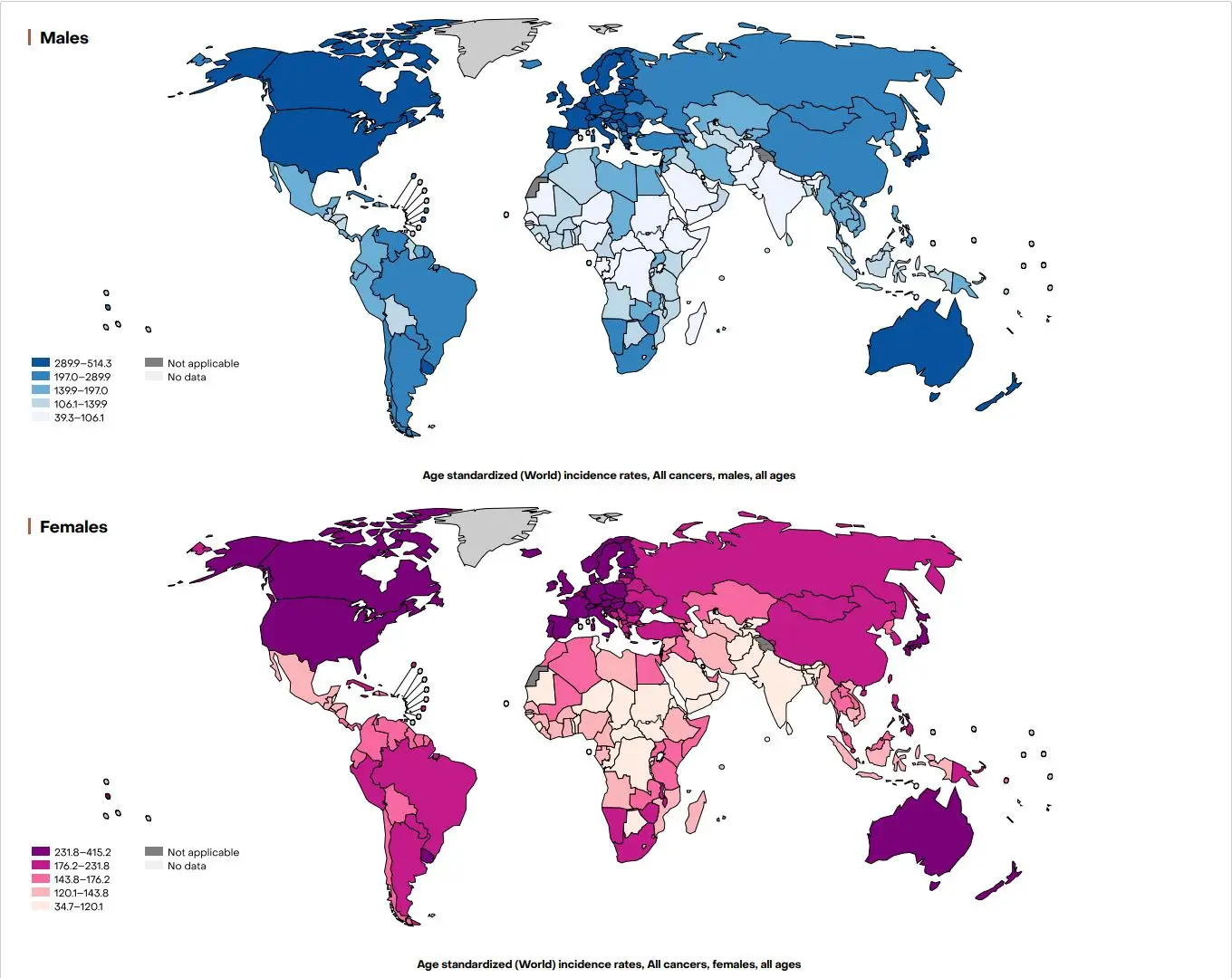
Graph production: IARC
One disease, many worlds: The 2022 global cancer picture
Pancreas: the quietest killer — 511K cases, 467K deaths. Nine in ten diagnosed patients do not survive.
The GLOBOCAN 2022 database, compiled by the International Agency for Research on Cancer (IARC) under the World Health Organization, covers 185 countries and puts the scale of the global cancer burden into sharp relief. The numbers are unambiguous: approximately 20 million new cancer cases were recorded in 2022, alongside 9.74 million deaths. Statistically, 1 in 5 people will be diagnosed with cancer during their lifetime; 1 in 9 men and 1 in 12 women will die from it. The table below shows new cases, deaths, case-fatality ratios, and 5-year prevalence from GLOBOCAN.

In 2022, approximately 20 million new cases were recorded and 9.74 million people died. Statistically, 1 in 5 people will face a cancer diagnosis at some point in their lives; 1 in 9 men and 1 in 12 women will die from the disease.
| Cancer | New Cases | Deaths | Case-Fatality % | 5-Year Prev. |
|---|---|---|---|---|
| Lung | 2.48M | 1.82M | 73.3% | 2.35M |
| Breast | 2.30M | 666K | 29.0% | 8.20M |
| Colorectum | 1.93M | 904K | 47.0% | 5.16M |
| Prostate | 1.47M | 397K | 27.1% | 7.89M |
| Stomach | 969K | 660K | 68.1% | 1.81M |
| Liver | 866K | 759K | 87.6% | 1.10M |
| Thyroid | 821K | 47K | 5.8% | 4.86M |
| NHL | 553K | 251K | 45.4% | 2.41M |
| Cervix uteri | 662K | 349K | 52.7% | 2.26M |
| Pancreas | 511K | 467K | 91.5% | 462K |
Source: GLOBOCAN 2022, IARC — Global Top 10: Cases, Deaths, Case-Fatality
But the most striking aspect of this table is not the size of the numbers — it is how sharply they diverge by sex and by region.
Two sexes, two separate lists
The global leader among men is lung cancer: 1.57 million new cases. It is followed by prostate (1.47M), colorectal (1.07M), stomach (627K), and liver (601K). The geography of this list is equally striking: prostate dominates in Western Europe and the Americas, while lung cancer tops the charts across Eastern Europe, Turkey, and Central Asia — regions where the tobacco epidemic arrived late and tobacco control has lagged. Stomach cancer holds first place in Japan, South Korea, and China, a pattern driven by H. pylori prevalence and diets rich in salted and fermented foods.
| Country / Region | Leading Cancer | Note |
|---|---|---|
| Turkey, Greece, Hungary, Serbia | Lung | High smoking prevalence |
| Russia, Belarus, Ukraine | Lung | Highest mortality rates in Eastern Europe |
| Mongolia | Liver | World’s highest male cancer death ASR |
| Vietnam, Cambodia, Laos | Liver | Endemic HBV/HCV infection |
| Japan, South Korea, China | Stomach | H. pylori + fermented food culture |
| Guadeloupe, Martinique | Prostate | Caribbean prostate burden |
| USA, Canada, Australia | Prostate | High screening rates |
| Western & Northern Europe | Prostate | High incidence, low mortality |
| Kazakhstan, Uzbekistan | Lung + Stomach | Double burden |
| India | Lip/Oral cavity | Smokeless tobacco use |
Table: Leading cancers by region and country — men.
Breast cancer alone accounts for 23.8% of all cancers in women: 2.30 million new cases — the highest of any cancer type across both sexes combined.
Among women, the picture changes entirely at the top.
Breast cancer alone accounts for 23.8% of all female cancers: 2.30 million new cases, the highest count of any cancer across both sexes. It is followed by lung (909K), colorectal (857K), cervical (662K), and thyroid (615K). Cervical cancer stands out in this list — not because it is inevitable, but precisely because it is not. HPV vaccination and screening programmes can prevent it almost entirely, yet it still kills 349,000 women a year. The vast majority of those deaths occur in low-income countries where neither the vaccine nor basic screening is reliably available.
| Country / Region | Leading Cancer | Note |
|---|---|---|
| Sub-Saharan Africa (all) | Cervix uteri | No HPV vaccine access |
| Moldova, Romania, Ukraine | Colorectum / Breast | Lack of screening infrastructure |
| Mongolia | Liver | HBV burden affects women too |
| Japan, South Korea | Stomach | Near-equal rates to men |
| Belgium, Luxembourg, Netherlands, France | Breast | Highest incidence globally |
| Turkey | Breast | Survival improving with screening expansion |
| USA, Australia, UK | Breast | High incidence, low mortality |
| Pakistan, Afghanistan | Breast + Cervix | Late diagnosis, high mortality |
| Southeast Asia | Cervix / Liver | Mixed burden |
| Northern Europe (Scandinavia) | Breast | Early detection leaders |
Table: Leading cancers by region and country — women.
Top 5 cancers by sex, visualised:
Incidence and mortality lists don’t match
One of the most misleading assumptions in reading cancer data is this: the most common cancer is not the most deadly.
Pancreatic cancer is the starkest example. With 511,000 new cases it ranks 10th in incidence — but with 467,000 deaths it climbs to 6th in mortality. That means 91 out of every 100 people diagnosed with pancreatic cancer will die from it. The reasons are well established: the disease produces no early symptoms, the pancreas is difficult to image, and no validated screening method exists for the general population.
Mongolia’s liver cancer tragedy: a small population, a world record — HBV and alcohol converging into a single crisis.
Liver cancer tells a similar story: 866,000 cases, 759,000 deaths — a case-fatality ratio of 87.6%. Oesophageal cancer sits third at 87.2%. At the opposite end of the spectrum, thyroid cancer recorded 821,000 new cases — ranking 7th — but only 47,500 deaths, a case-fatality ratio of just 5.8%.
Thyroid: invisible epidemic or overdiagnosis? — 821K cases, only 47K deaths.
This paradox points to the growing sensitivity of modern imaging: small tumours that may never have caused clinical symptoms are now being found and counted. It is, in effect, the data signature of the overdiagnosis debate.
Is geography destiny? A 5-fold gap across regions
Where you are born shapes which cancer will reach you — and whether you will survive it. In Australia and New Zealand, the age-standardised incidence rate (ASR) for men stands at 508 per 100,000. In West Africa, the same figure falls to 97. North America and Western Europe also rank high — a result of both ageing populations and the capacity to detect cancers early through organised screening.
When a country screens more, it finds more. This does not mean those populations are intrinsically more cancer-prone — it means the health system is doing its job. Conversely, low incidence rates in low-income regions often reflect diagnostic gaps rather than low disease burden. The deaths that follow make this clear.
High incidence does not mean high mortality. In fact, the opposite holds: wealthier countries find more cancers and lose fewer patients. Low-income countries register fewer cases — because diagnosis infrastructure is inadequate — but a far higher proportion of those diagnosed will die.
| Region | Male ASR | Female ASR | Gap (M−F) |
|---|---|---|---|
| Australia / New Zealand | 507.9 | 410.5 | +97.4 |
| Northern America | 422.0 | 338.7 | +83.3 |
| Western Europe | 378.0 | 325.4 | +52.6 |
| Northern Europe | 358.6 | 323.9 | +34.7 |
| Southern Europe | 320.4 | 253.1 | +67.3 |
| Eastern Europe | 299.3 | 220.7 | +78.6 |
| Southern Africa | 241.8 | 196.0 | +45.8 |
| South America | 220.6 | 200.8 | +19.8 |
| Eastern Asia | 215.2 | 164.0 | +51.2 |
| Caribbean | 213.7 | 185.4 | +28.3 |
| South-Eastern Asia | 167.3 | 148.1 | +19.2 |
| Western Asia | 160.3 | 152.4 | +7.9 |
| Northern Africa | 141.2 | 130.5 | +10.7 |
| Central America | 138.5 | 150.2 | −11.7 |
| Eastern Africa | 121.3 | 127.4 | −6.1 |
| Middle Africa | 112.4 | 116.8 | −4.4 |
| South-Central Asia | 116.0 | 103.3 | +12.7 |
| Western Africa | 97.1 | 110.6 | −13.5 |
The most dramatic illustration of this geographic divide is cervical cancer. In Belgium, it has effectively been removed from the list of major health concerns. In Eswatini, Malawi, and Zambia, it remains the leading cause of cancer death among women. A cancer that is entirely preventable — through a vaccine that has existed since 2006 — continues to kill in the countries least able to afford it. That is not a biological fact. It is a policy failure.
A pattern without borders: The tobacco belt and the HPV gap
Two preventable risk factors — tobacco and unvaccinated HPV infection — explain a disproportionate share of the global cancer burden, and both follow the same logic: they hit hardest where policy has moved slowest.
Eastern Europe and parts of Western Asia carry among the world’s highest lung cancer death rates in men. Smoking prevalence peaked decades later than in North America or Scandinavia, and tobacco control legislation lagged accordingly. The consequence is visible in the data: countries such as Turkey, Hungary, Serbia, and Greece cluster at the top of male lung cancer incidence rankings — not because their populations are biologically more susceptible, but because cigarettes were cheaper, more available, and less regulated for longer.
High cancer incidence in wealthy nations is not only bad news — it is partly the signature of a functioning health system that finds cancers before they kill. The real red flag is high mortality paired with low incidence: cancers being missed until it is too late.
The HPV gap follows the same political economy. The vaccine has been available globally since 2006 and is cost-effective even in low-income settings. Yet across sub-Saharan Africa, coverage remains critically low. Cervical cancer incidence in that region is roughly three times higher than in Western Europe. These are not projections — they are 2022 data.
What does this data actually measure?
- Data source: GLOBOCAN 2022 (v1.1, 08.02.2024), IARC — gco.iarc.who.int
- Publication: Bray F. et al. Global Cancer Statistics 2022. CA Cancer J Clin, 2024
- Coverage: 185 countries, 36 cancer types, reference year 2022
- Indicators used:
- New cases (incidence)
- Deaths (mortality)
- 5-year prevalence
- Age-standardised rate (ASR) — World standard, per 100,000
- Case-fatality ratios were calculated by the author as deaths ÷ new cases × 100; clinical survival analysis requires cohort data.
In low-income countries, incidence and mortality estimates rely on statistical modelling rather than direct registry data. ASR comparisons control for population age structure, but diagnostic capacity differences may still affect incidence estimates.
Key findings at a glance:
- 19.97 million new cancer cases were recorded in 2022; 9.7 million people died.
- Lung cancer was both the most common (12.4%) and the deadliest (18.7% of all cancer deaths) across both sexes.
- Top 5 in men: Lung (1.57M), Prostate (1.47M), Colorectum (1.07M), Stomach (627K), Liver (601K).
- Top 5 in women: Breast (2.30M — 23.8% of all female cancers), Lung (909K), Colorectum (857K), Cervix (662K), Thyroid (615K).
- Breast cancer leads in 5-year prevalence: 8.2 million women alive — reflecting high survival rates.
- Thyroid cancer paradox: 821,000 new cases but only 47,500 deaths — common, but rarely fatal.
- Cervical cancer occurs at 3× the rate in low-income countries compared to high-income countries — despite being entirely preventable.
- Regional gap: Male ASR in Australia/New Zealand is 507.9 per 100,000; in West Africa it falls to 97.1 — a 5.2-fold difference.
- High-HDI countries show 2.5× higher cancer incidence but lower mortality — the early detection effect.
- Prostate cancer disproportionately high in Caribbean nations, particularly Guadeloupe and Martinique.
Data Journalist: Onur Metin | HepsiVeri.com