

Haberin Türkçesi için buraya tıklayabilirsiniz.
At the top of the priority list: cost of living, security and the fight against poverty
The European Parliament’s Winter and Spring 2025 Eurobarometers, together with the European Commission’s “EU challenges and priorities” Flash Eurobarometer 569, map which policy areas EU citizens expect both the Parliament and the Union as a whole to prioritise. The data show that, for citizens, the cost of living, defence and security, and the fight against poverty and social exclusion top the agenda, while the EU’s strongest asset is still perceived to be democracy and human rights. So, according to the surveys, what do citizens in the EU expect from the European Parliament?
Dataset and methodology: three different Eurobarometers, one common picture
The analysis is based on three core sources: the European Parliament Winter 2025 Eurobarometer, the European Parliament Spring 2025 Eurobarometer and the November 2025 Flash Eurobarometer 569 “EU challenges and priorities”.
Links to these publications are provided at the bottom of this page.
- European Parliament Winter 2025 Eurobarometer: face-to-face interviews (in some cases video-assisted) with 26,354 people across 27 Member States between 9 January and 4 February 2025.
- European Parliament Spring 2025 Eurobarometer: fieldwork with 26,410 respondents in the same 27 Member States between 5 and 29 May 2025.
- Flash Eurobarometer 569 “EU challenges and priorities” (published November 2025): an online survey carried out with 25,893 EU citizens between 3 and 10 September 2025.
In all three studies, multiple-response questions are used across the EU-27; citizens are asked both about “the EU’s strengths and challenges” and about “which policy areas should be prioritised at EU level and at Parliament level”. The result is a “European agenda” in which perceptions of crisis crystallise around the economy, security and social vulnerability.
In this article, all the questions shown in the charts allow respondents to select up to three answers. The charts are taken from the explanatory material of Flash Eurobarometer 569 “EU challenges and priorities”, while the text also draws on findings from the other Eurobarometers.
Expectations from the European Parliament: first the wallet, then the shield
The European Parliament’s Winter 2025 Eurobarometer reveals a clear triangle of priorities in the answers to the question “Which issues should the European Parliament prioritise?”
For respondents, the top issue to be addressed is inflation. This is followed by security and by job creation to support the economy and tackle poverty.
43% of respondents identify inflation, rising prices and the cost of living as the first issue the Parliament should address. A further 31% highlight the EU’s defence and security. The fight against poverty and social exclusion also ranks on the second tier with 31%. Support for the economy and the creation of new jobs emerges as another key priority at 29%, completing the list.
In the Spring 2025 wave, the picture is almost identical: when respondents rank the issues they want the European Parliament to prioritise, inflation, rising prices and the cost of living again comes first with 41%; defence and security is second with 34%; and the fight against poverty and social exclusion is third with 31%.

In other words, across two separate fieldwork periods, the message remains unchanged: citizens expect the Parliament to prioritise policies that protect their wallets, while simultaneously strengthening defence and social protection components.
This configuration continues the trend observed after the 2024 European elections: the cost of living was the dominant concern during the campaign period and remains at the top of the agenda in 2025.
Priorities at EU level: defence, competitiveness and irregular migration
When citizens are asked not only about the Parliament but also about the EU’s overall policy agenda, a similar security–economy axis emerges.
In the European Parliament’s Winter 2025 survey (report dated 25 March 2025), defence and security and competitiveness, the economy and industry stand out as the two most critical areas for strengthening the EU’s position in the world (36% and 32% respectively).
The Spring 2025 wave (report dated 3 September 2025) confirms this picture: the main areas the EU should focus on are again defence/security (37%) and competitiveness/economy/industry (32%).
These findings are consistent with the Commission’s Flash Eurobarometer 569 “EU challenges and priorities”. In the same questionnaire, when respondents are asked about the policy areas the EU should address as a priority:
Security and defence ranks first with 34%; irregular migration follows closely with 32%; and the war in Ukraine comes third with 27%. The remaining top issues in the dataset are shown in the infographic below.
In summary, citizens’ priority list at EU level is structured around hard security (defence, migration, war) and economic capacity, while at Parliament level the same framework makes the “kitchen-table economy and social protection” dimension more visible.
Crisis matrix: today the war in Ukraine, tomorrow global conflicts and climate
The Flash Eurobarometer 569 data capture European public perceptions of crisis through two lenses: the main challenge today and the biggest global risks for the future.
For the here and now, responses to the question “What are the main challenges the EU is facing?” are as follows:
- The war in Ukraine tops the list with 47%;
- Irregular migration stands at 38%;
- The cost of living at 29%;
- Climate change and environmental issues at 29%;
- Security and defence-related issues at 29%;
- Insufficient economic growth at 22%, and crime and terrorism at 21%;
- Disinformation and information manipulation and the conflict in the Middle East at 18%; social inequalities at 17%; and the impact of digital technologies on society at 7%.
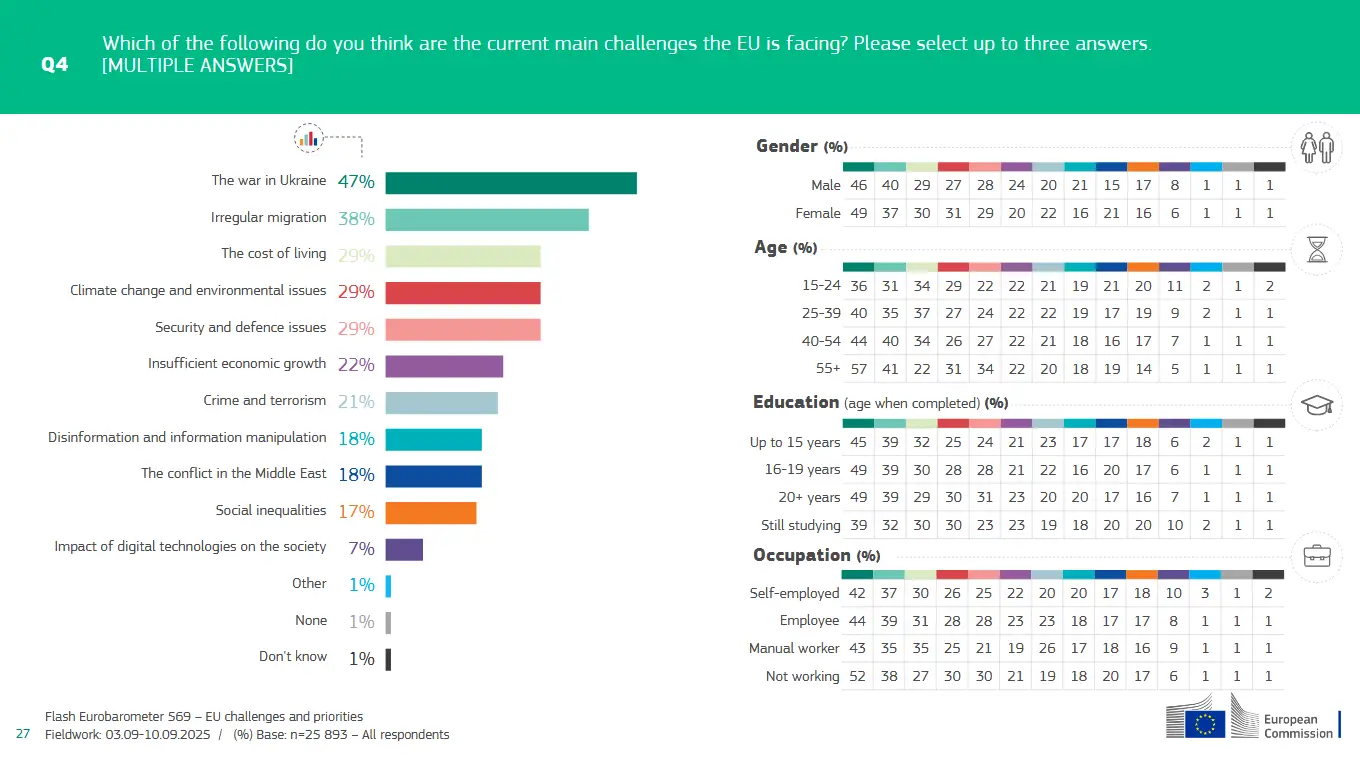
The following written areas are seen as priority for EU.
When it comes to perceptions of global risks for the future, the picture is layered as follows:
- Conflicts around the world rank first with 41%;
- Irregular migration follows with 35%;
- Climate change and environmental problems are cited by 31%;
- The risk of the EU losing its voice and influence in the world enters the list as a new source of concern at 30%.
This combination suggests that, in the short term, crisis perceptions are centred on the “war in Ukraine”, while in the medium to long term a broader climate of insecurity emerges around conflicts, migration, climate and the risk of geopolitical power loss.
The EU’s strengths: democracy perceived as robust, priorities more fragile
The same Flash Eurobarometer 569 also asks citizens about the EU’s “greatest strengths”:
- Respect for democracy, human rights and the rule of law comes first with 36%;
- Economic, industrial and trade power is second with 31%;
- Good relations and solidarity between Member States is third with 28%.
Subsequently, when asked which values the EU represents better than the rest of the world, more than half of respondents position the EU more positively than other actors in terms of fundamental rights and freedom of expression (55%), as well as social equality and welfare (52%).
However, in the policy priority questions that follow directly after this strong value perception, the top of the list is occupied by security, migration, war and the cost of living. An EU that is seen as a “democracy project” at the level of values is, in citizens’ eyes, tested at policy level in its role as a “protective shield and economic actor that makes everyday life sustainable”.
The issues citizens in the European Union most frequently identify as “threats to democracy” are as follows:
- False/misleading information circulating both online and offline in general – 37%;
- Growing distrust and scepticism towards democratic institutions – 35%;
- Propaganda and false/misleading information coming from authoritarian foreign actors – 33%;
- Covert external interference in national politics and economies (including the financing of domestic actors) – 30%;
- Citizens’ lack of interest in politics and elections – 26%.
Political reading: the security–economy–social protection triangle
When the dataset is read as a whole, the following framework emerges:
Citizens still perceive the EU as a positive exception globally in terms of democracy, human rights and the rule of law.
By contrast, the concrete priorities expected from the Parliament and the EU largely focus on a policy mix that curbs inflation and the cost of living, strengthens defence and security, and reduces poverty and social exclusion.
This sends a clear signal to political actors. Budget debates, the new EU multiannual financial framework and the Parliament’s policy agenda cannot be organised solely around geopolitical risks and military cooperation; they must also be structured around the kitchen-table economy and the reduction of social vulnerability.
Otherwise, the gap between the EU’s legitimacy at the level of values and the sense of vulnerability in citizens’ daily lives will widen further. This dataset provides a numerical diagnostic of exactly along which axes that gap is expanding.
Story: Onur Metin |hepsiveri.com
Did you find this story useful? Would you like someone else to read it too?
Then please don’t hesitate to share it!
Sources
European Parliament Winter 2025 Eurobarometer: face-to-face interviews (in some cases video-assisted) with 26,354 people across 27 Member States between 9 January and 4 February 2025. Link
European Parliament Spring 2025 Eurobarometer: fieldwork with 26,410 respondents in the same 27 Member States between 5 and 29 May 2025. Link
Flash Eurobarometer 569 “EU challenges and priorities” (published November 2025): online survey conducted with 25,893 EU citizens between 3 and 10 September 2025. Link